



Frozen Hearth Review
Imagine, if you will, that you play chess. Imagine that you get some modicome of happiness over a well strategized game. Now imagine that your best friend tells you that you should play his buddy Albert, because Albert is ‘a pretty challenging player’. You decide to give it a go. After all, challenge is what makes the game fun, right? Even if you get creamed by Albert, maybe you’ll learn something in the process, right? Well, one weekend you finally meet up with Albert and suggest playing a game. Albert happily agrees – and then whisks out a tiny coaster-sized chessboard to play on. He then explains that all the pieces are made out of carefully crafted bubbles. Furthermore, in this variation of chess, you are only allowed to move the pieces using tweezers. Just to add a challenge, your tweezers may only be held between your toes of your foot. And it can’t be your dominant foot, either: only your non-dominant foot will do. Think of the challenge! Think of how intriguing and difficult it would be to play Albert! Think of the hours you could spend on just a single game! Do you have that image firmly ingrained in your head? Congratulations, you are now ready to play Frozen Hearth.
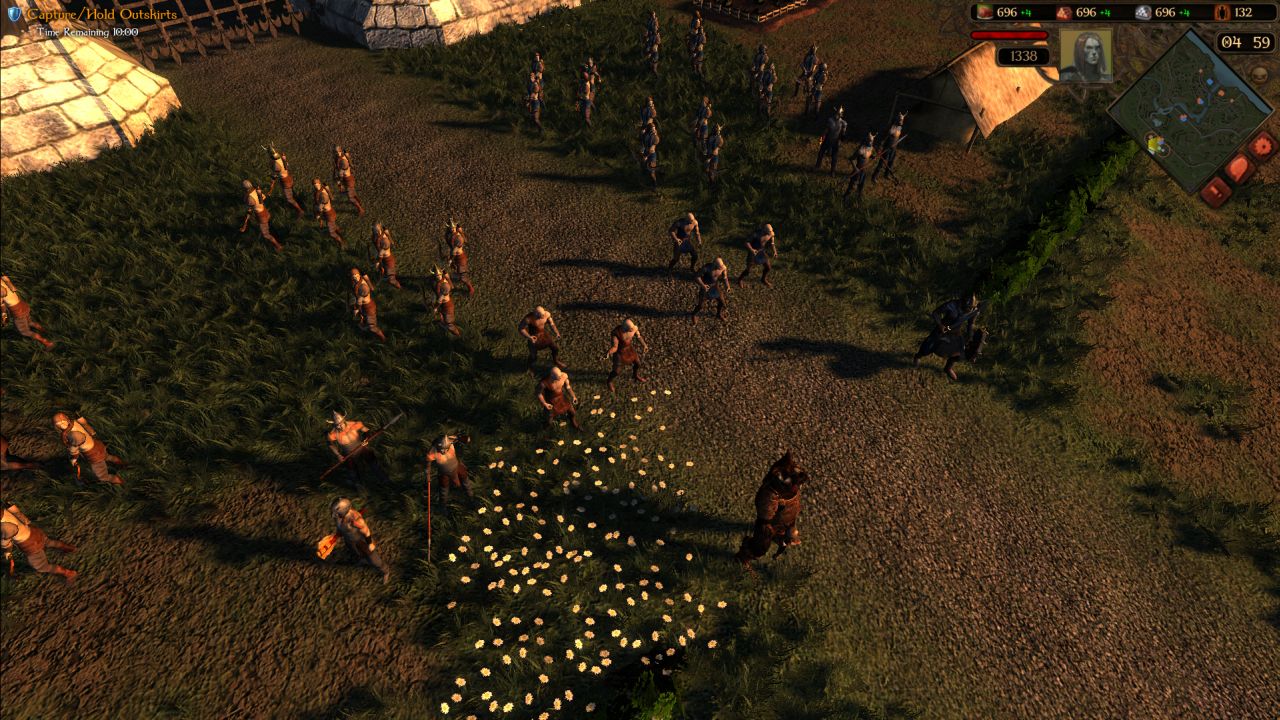
I suppose it’s my duty to say something nice about the game first. Gameplay in Frozen Hearth is wisely kept to straightforward RTS basics. Your army is centralized around one very strong spellcaster hero, chosen from a set of three possible characters. While gathering experience from combat, your hero gains level points that may be spent on-the-fly on upgraded stats and more spell possibilities. In both the campaign and multiplayer, resource gathering is based on capture-points, which has become a solid standard among modern RTS games. All of this seems simple enough so far. Frozen Hearth’s marketing online makes a great deal of its “co-op” campaign, but the levels here aren’t actually cooperative: they merely have enough room for two players on the same field.
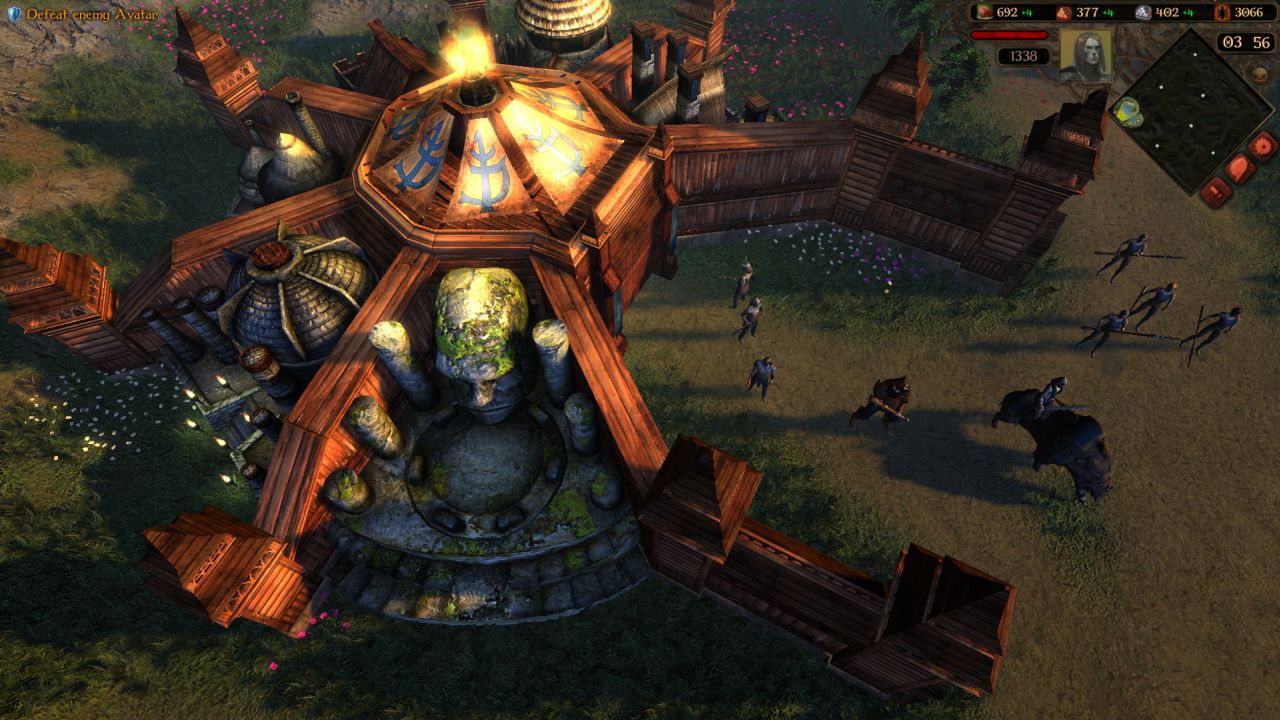
The one spark of originality in the game comes from the fact that in multiplayer matches, your entire base is simplified down to a single building, from which all of your units are trained, and all of your upgrades are available. This central town hall is divided into six pie pieces around a central hub, and as you progress through the tech trees of your faction, each pie piece can be devoted to a particular tech building, such as a Chapel or a Foundry, to allow for unit upgrades and more diverse unit combinations. Spellcasters have a dizzying array of possible spells to use: auras, area damage, healing, and so forth. Each spell can be further researched as your hero levels up, but for the most part there are so many spells with such a combination of possibilities that they tend to feel watered down after a little while. Your typical aura might give +15% movement speed, firing rate, and hp, or maybe +20% healing and dodge chance, for example, but this means that there aren’t really any game-defining abilities that are a pleasure to use or focus your hero around. This style of ability might just be your thing: after all, Warcraft III had a very similar system on its release, and some people particularly liked it.
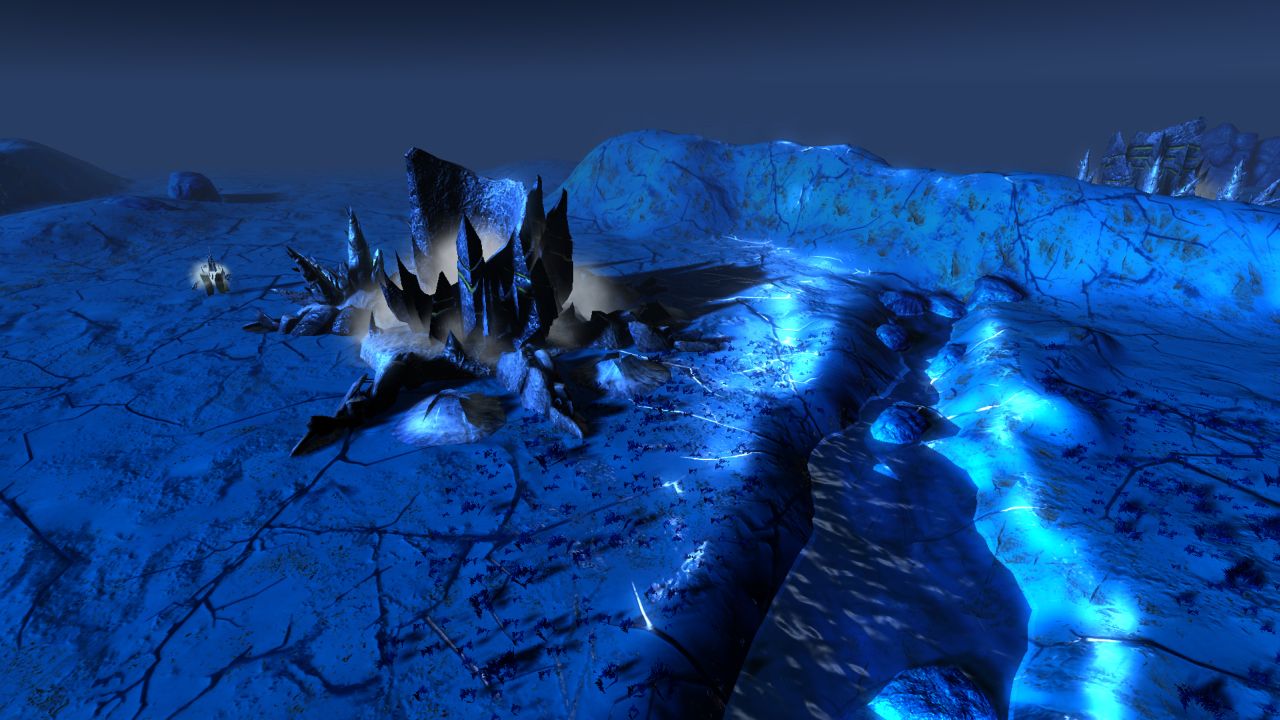
Another moderately painless aspect of Frozen Hearth is the world building. The setting is a semi-fantastic Nordic environment, with your units having a delicious array of accents and face paints to give character. The game also makes a bit of an attempt to include ice as a gameplay element; where your vicious demon foes spawn and fight, the ground becomes frosty and cracked, and the edges of your screen become white-speckled as well. Sadly, this is just about the greatest stretch of fictional creativity that the game can muster: there’s simply not much effort put into giving the fantasy world of Amorra a sense of individuality. Even the demonic monsters who you are fighting seem very cobbled together, without any particular style or theme, and then splashed with red stripes (because, you know, red is the scary color, right?). There is essentially no story or character development to speak of: instructions are given to you from a nameless “advisor”, but otherwise there’s little effort to give either the fantasy world or the level situations any depth.
At this stage in the review, you may think that Frozen Hearth is a moderately playable if not particularly inspired RTS. But sadly, Frozen Hearth feels for all the world like a game that was entirely written out on paper, then instantiated and released with little or no play testing. The result is that the controls are simply too incredibly clunky to allow the player to enjoy any of the game’s depth. There’s a gem of an illustrative example in a single two-word phrase: “attack move”. Try as I might, I simply couldn’t find a way to tell my units to attack-move in this game (that is, move to a location and attack any enemy combatants encountered). This seems like minor oversight, simply a nice feature that didn’t quite make it onto the list of “things we want in this game”. But consider the implications for a minute: your troops simply cannot travel unsupervised, because if they stumble upon an enemy squadron during their trip to a resource node, they will happily be chewed to bits rather than be deviated from their goal. Every RTS game has a normal move option, of course: it’s useful for escaping, or for forcing your way through enemy lines to a particular goal. This is no excuse for leaving out the entire other half of all movement in RTS history.
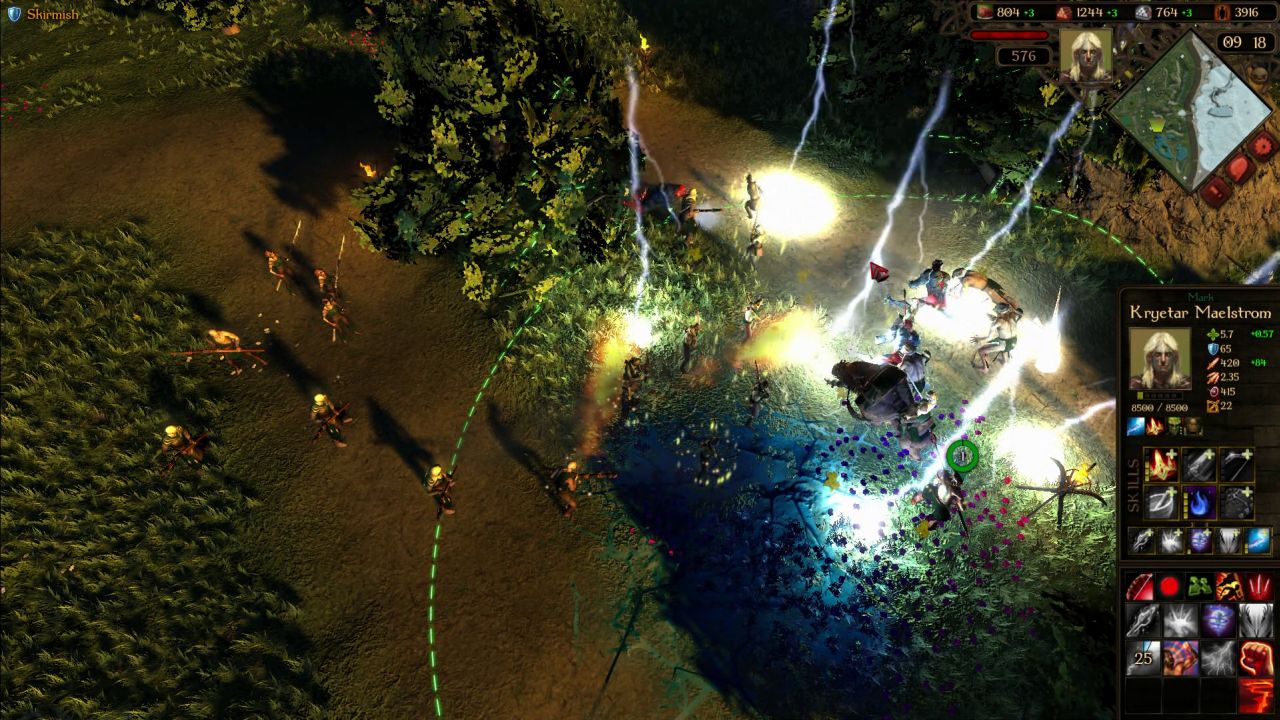
What do we have instead? Something deep and dark. Something that sounded good to somebody somewhere along the line of this game’s development. And that something’s name is called “the stance system”. Your units are given ‘stances’ which dictate their behaviour when at rest: they may be set to attack all enemies on sight, or to only attack when fired upon. These starting stances seem alright, but the system quickly devolves into madness: one stance for preferring ranged combat over melee, one for attacking only buildings, and worst of all, the paragon of unnecessary clutter in an RTS, on stance that simply commands your units to never attack anything at all. I simply cannot imagine a single instance when this final stance would ever be handy, even given the most tortured gaming scenario. But just to make things extra difficult, the eight or so stances are all cycled through the same button, meaning that if you want your units to take a particular stance, you need to click several times to find the right one.
The lack of attack-move, coupled with the incredibly clunky stance system, means that Frozen Hearth has somehow managed to make difficult the simplest and most fundamental aspect of every single RTS game ever made: getting your units to attack enemy units. Think about that for a second: this is an RTS game in which it’s actually a bit of a headache to figure out how to get your units to attack your enemy. You can move your units near the enemy, and then fiddle around with their stances until you strike one that lets them attack (most don’t), and then your units might go ahead and go for it. Or you can order all of your selected units to fire on a single enemy, if you don’t mind going through the game focus-firing every single enemy unit. In my playing this game, I lost the very same level not once, but twice, simply because my soldiers stood smiling by as demonic monsters walked right up to them, slowly ate half of their bodies, and then continued on to the packbeast I was meant to protect. Even after specifically preparing for the onslaught, I could not figure out how to get a spearman to respond to the pair of jaws working up his leg. Maybe I’m just to dumb to figure the game out. Or maybe Frozen Hearth is like playing chess by using a pair of tweezers held between your toes.
I wish I were writing an obituary for Frozen Hearth, because then I could at least chuckle to myself when I reach as deep as I can for the nicest thing I can think to say about the game, and I come up with “difficult”. Sometimes you come across a real tragedy in indie gaming when a studio produces a unique and nigh avant-garde approach to a genre, but doesn’t quite have the polish to pull it off. In these cases, it’s sad to see a creative idea so harshly blocked by mechanics and quality issues. But Frozen Hearth slips one solid step below this level: behind its flaws lies not a new idea or an intriguing premise, but just a mediocre RTS at best, and at worst, a pain to play.