



Tiny and Big Review
There’s a special type of creativity that most people stumble upon during their teenage years, and sadly leave behind as they try to grow up. It’s that excited love of spontaneous storytelling and improvisation that shows up on crude notebook drawing epics and silly hand-puppet skits. It’s the feeling you have when you not only laugh at how silly your dog looks wearing a cape, but you start taking pictures and wind up late at night with a home-made comic book about your superdog. In short, it’s right between that giddy anything-goes attitude of childhood, and the ability to develop it into something bigger.
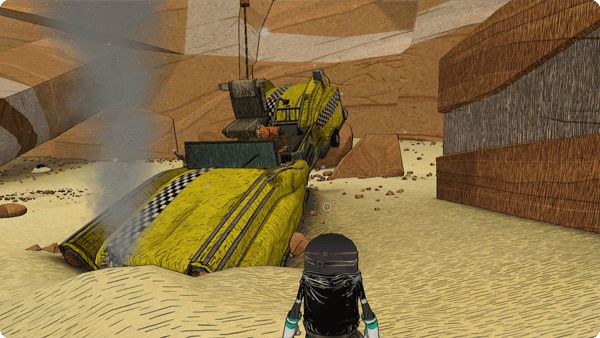
Tiny & Big is made firmly in this unique creative space. You play an odd, misshapen munchkin named Tiny who is hunting desperately across the desert in an attempt to regain his grandfather’s stolen underpants. These precious drawers of destiny apparently have a mystical power, of which the main character is completely unaware (he only wants his heirloom-laundry restored to its rightful owner!). Assisting him on his hunt is his trusty sentient radio (who spouts good advice and good music to ease the journey), and his trusty sentient taxi (who crashes at the beginning of the game and is promptly abandoned). It’s funny, spunky, and childlike without being childish.
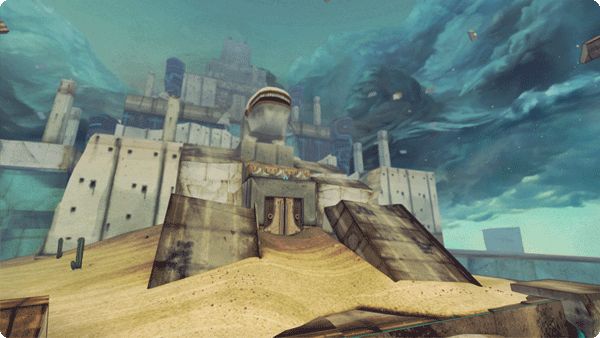
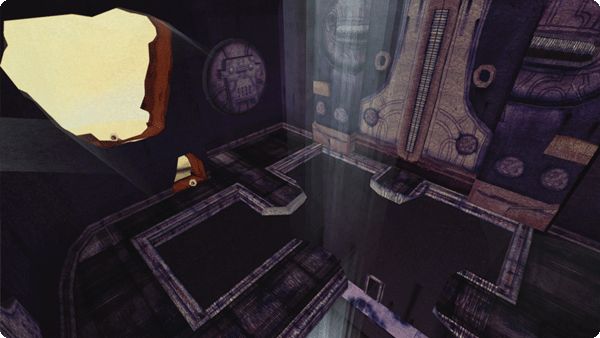
Perfectly accentuating the odd storyline is the environment of the game, which takes place in what looks for all the world like a southern Arizona desert. There’s a little bit of salty sand and dust, but mostly there are great giant slabs of smooth granite and sandstone. Sometimes these are natural pillars, sometimes they’re carved columns and bridge sections, but the world of Tiny & Big is a world of slabs of rock. Tiny traverses through dark canyons, abandoned ruins, and immense crumbling temples that take a delightful inspiration from Native American artwork and architecture. Maybe it’s just a pet project of mine, but the Native American aesthetic in general feels like a rich and underused visual theme for video games, so it’s nice to see it put to such good use, and I specifically say ‘put to use’ because this rocky, blocky desert is the perfect place for Tiny & Big’s main gameplay focus: environment manipulation.
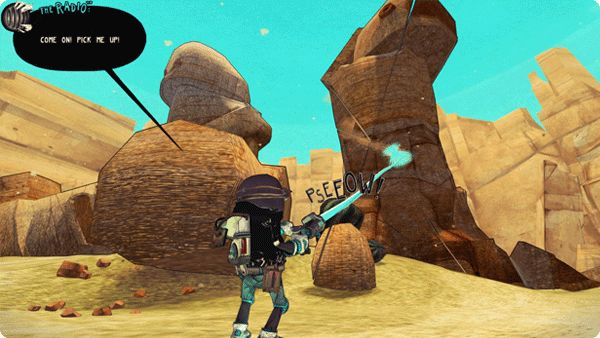
Your character has three tools at his disposal. You can skewer a block with a grappling line to let you pull it in a direction. You can also shoot a rocket into a block to push it instead. If the tool selection stopped here, Tiny & Big would be a painfully boring game, but the final tool is what makes the game: a laser that cleanly slices through rocks. This allows you to cut boulders up into smaller pieces, tip over giant pillars, or crack up sections of bridges. If you need to get over an un-cuttable wall, you can slice up an appropriate slab of rock and push it over to make steps, or cut up a longer slab and pull it over to make a ramp. Since the laser only cuts in one clean, straight line, you need to be careful in your selection of where to cut, and since you can’t put pieces back together, you need to be conservative with your cuts.
I hesitate to call Tiny & Big a ‘puzzle’ platformer simply because of how freeform the puzzling turns out to be. You need to use your rocket, rope, and laser in order to advance, but since the rocks will fall strictly according to the laws of physics, there’s never any one solution to a problem. If you meet a gap you need to cross, there’ll probably be two or three ways to cross it. If you accidentally knock a vital boulder off the edge of a cliff, more likely than not you’ve got an extra one nearby that you can rope in. One pleasant side effect of physics-based puzzling is that it gives the game decent replay potential: it might be the rare case where you use the same method to solve a repeat puzzle. This is nicely proved throughout the game itself: if you want to over-simplify, you can only meet two real obstacles to stop you from going forward, either a pit that’s too low or a wall that’s too high. You’d think that these options would get boring quickly, but the level designers were spot on in providing a wide variety of approaches.
Just when the puzzling starts to get boring, the game wisely switches to more action-oriented gameplay, where our most appropriately-named hero Tiny must use his tools to deflect giant blocks being thrown at him by the Thief, as they both battle through obstacle course terrain. It’s a welcome relief, but the sad truth is that even this gets a little tiresome as the game goes on. It doesn’t help that the controls, while adequate, do not feel particularly finely tuned. In a game filled with sheer cliffs and tricky jumps, the wonky camera and touchy directional controls can get in the way every now and then.
Aside from basic level progression, the game throws some minor goals at you to keep things interesting, one of which is delightful, and one of which is pitiful. The delightful extra is the hidden cassette tapes: each one you get unlocks access to another music track for you to listen to as you play. It rewards your exploration or extra cliff-jumping with the chance of novelty and entertainment, and the music in Tiny & Big is excellent enough that the tapes warrant the extra effort. The tracks cover a wide range of genres focusing around country, folk, and Hispanic sounds. The disappointing extra comes in the form of ‘boring rocks’. That’s what the game calls them. They glow, you collect them, and at the end of the level, the game tells you whether you found them all. This feels like one step below gold rings or coins, which are themselves already the absolute lowest form of motivation in a game. The designers try to poke fun at themselves by deliberately calling these stones ‘boring rocks’, and I understand that they’re trying to be ironic, but it turns out that the rocks ARE boring after all, and that’s…. eh… ironic. I think. Sadly, hunting down rocks and chopping up rocks and climbing up rocks does eventually get a little boring, despite the effort the game makes. So Tiny & Big is best played in small spurts, and probably won’t have enough meat to keep you glued for more than an hour at a time.
Tiny & Big is spunky and funny, but in the end a little lacking in juicy gameplay, and even though the visuals and music are above average, they’re not quite enough to make up for the other parts of the game’s defects. That said, if you’re in the mood for a little desert scramble and want something to pass the time, this little title will keep a smile on your lips.