



Kinect Sports Rivals Review
It has been over 3 years since the debut of the original Kinect for the Xbox 360. While this voice and motion tracking device from Microsoft has seen various integrations in a range of titles, the sports genre was always a well suited application. From launch title Kinect Adventures to Kinect Sports, to more exercise-focused entries like Kinect Nike Training, the device has kept many players active. With the launch of Kinect 2.0 alongside the Xbox One, Microsoft once again aims to get players moving with the help of Rare Ltd and Kinect Sports Rivals.
As expected from a first-party title that aims to utilize the Kinect peripheral to the fullest, Rivals allows players to navigate the Island Map with gestures or voice commands. The island represents the game’s main menu and nicely outlines all activities that are available. Both the motion and voice controls function well and can be used to swiftly navigate to the desired menu. If you’re feeling lazy, a controller can still be used as well.
You begin by creating your Champion avatar. Unlike most games, you don’t use a pre-made persona or spend an unnecessary hour fiddling with the details. Instead, the game guides you through a scanning process where your body and face is scanned by Kinect into the game. The results are satisfying – your Champion will indeed look a lot like you, even determining your correct body type and some facial features. We’ve tried the process with a few players and the results were always accurate enough to satisfy and not require much further fiddling. It’s a cool feature, and one that ensures your Champion has a unique look, at least in the local player pool. You’ll run into many avatars that look strikingly similar as you venture online, but at least it’s a cool process to go through. You can always customize features such as hair, eyes, and body type or even restart the scanning process if you’re unhappy.
Once you’re ready, the real competition begins. You’re introduced to each of the six sports in Rivals via a series of tutorials, hosted by the amusing Coach (voiced by William Hope of Aliens). These cutscenes show off the three teams that compete in each event, namely the Eagle Legion, Wolf Clan, and Viper Network. The members of each of these teams are forgettable (and in case of Viper, annoying) stereotypical characters, that attempt to give the game some personality. Following the tutorials, you’ll play through a few team story events as a career mode of sorts. These story events are few in number and only act as incentive to run the players through each sport a few times. After that, you can actually choose what team you want to represent, and it feeds into a bigger meta-game of trying to lead your team to dominate all the sports on the island.
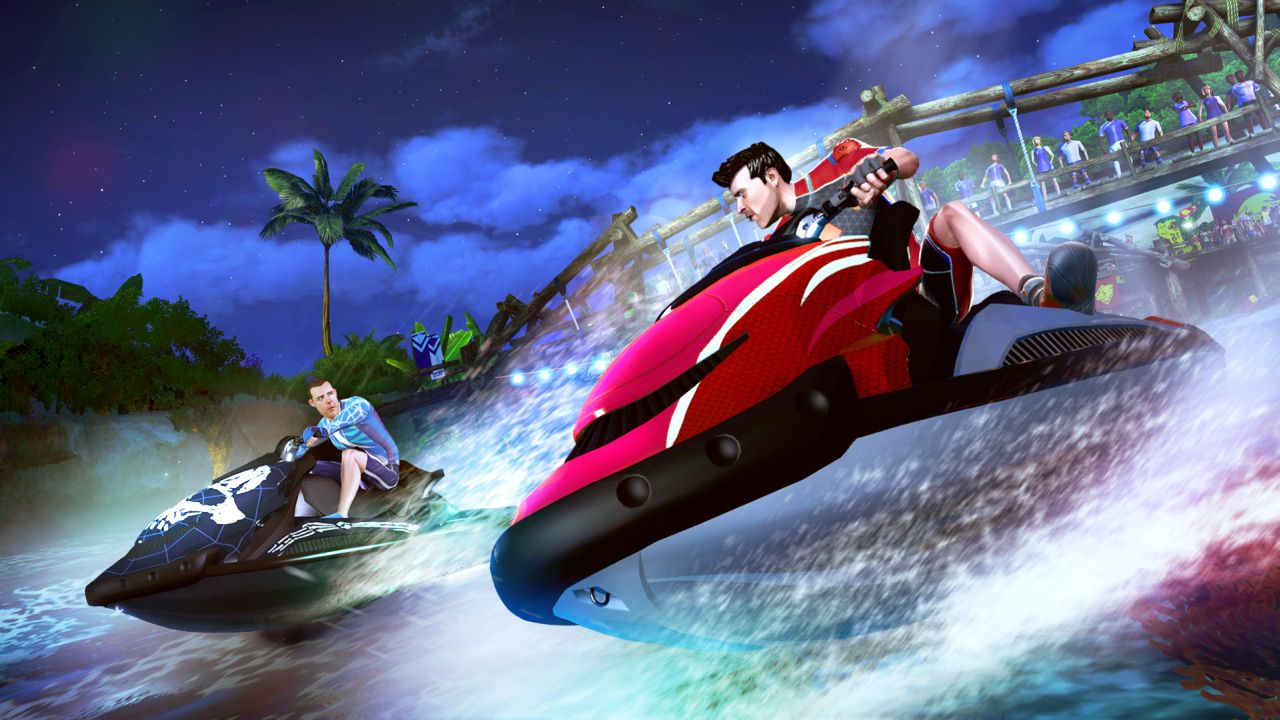
But let’s talk about the meat of the game: the six sporting activities. First up is Wake Racing, where places take on one of 5 circuits of varying difficulty. The gameplay consists of holding your hands in front, and steering by moving one of your hands closer to your body in a horizontal line. Your right fist must remain closed to keep the throttle down, and for sharp turns you must also lean your body in the desired direction. It’s a bit awkward to get used to, given that most players will be familiar with a steering wheel configuration of up/down instead of forwards/backwards. But, the controls are responsive enough that they don’t get in the way of the fun once you’re familiar with the setup.
Each sports game has a set of 3 functionally similar power-ups, one for speed, one for attack, and one for defense. They have different methods of being charged up, and can be executed with motion or voice. In wake racing they are Force Shield, Speed Boost, and Mine Drop. Players that want to win will likely stick to the speed buff, as the others are too situational, and the tracks already have plenty of obstacles and mines to crash into for the lesser skilled drivers. To earn the power-up, players will need to perform tricks from ramps or particularly large waves. Aside from occasionally getting stuck in the environment, and the game taking too long to reset you back, wake racing is an enjoyable introduction to Rivals with good controls and balanced mechanics.
Next up is Climbing, where players use their hands to climb a variety of horizontal surfaces at six different locales. Using your hands just like you would in a real situation, players grab air above them and pull their hands down in an alternating manner. You occasionally have to jump, or scale sideways. The Kinect tracks your hands well, though too often the next ledge is closer than your fully outstretched hand, so you must fiddle and move your hand around until it’s suitably positioned. This wastes valuable time, as does an odd mandatory resting period to recover your Champion’s stamina, lest you want to fall off.
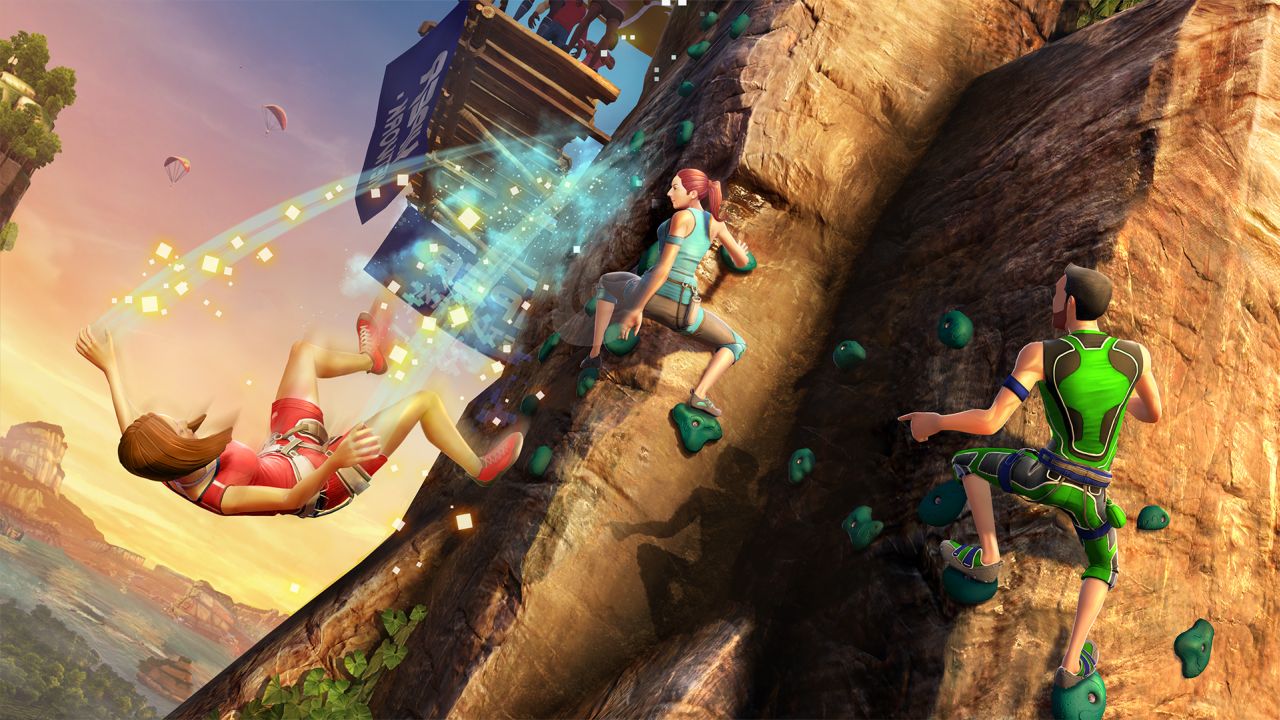
To make your experience more interactive, players can actually grab the competition and throw them off, which can be avoided if you keep your distance. There are also unstable ledges that crumble, shock you, and gusts of wind that can ruin your day. If you do fall off though, like in wake racing you simply restart from the same spot, though have lost valuable time. The three power-ups in climbing are shock shield, super jump, and blast wave. Unlike wake racing, players might actually want to experiment with which ability works best for their strategy. Do you protect your own ascent with a shield, or try to harass others with the blast wave? Climbing offers an enjoyable balance between fun and exercise that works well if the Kinect tracking cooperates.
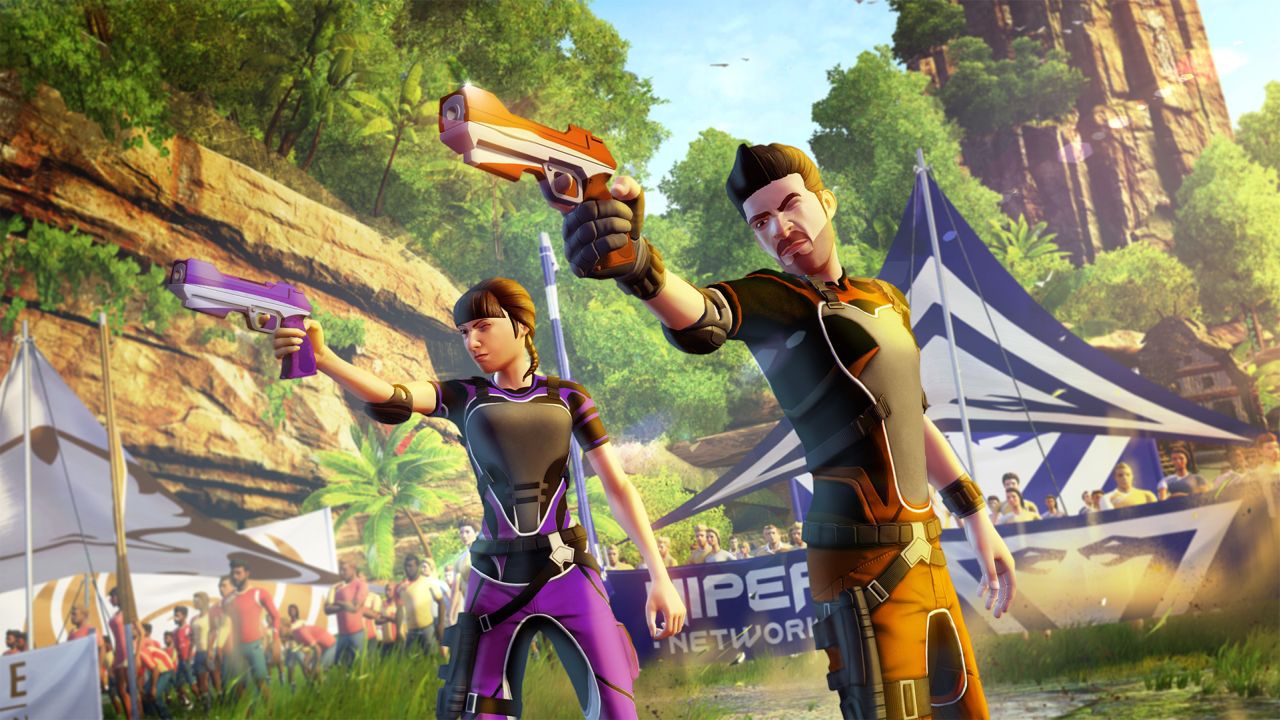
With Target Shooting, Kinect Sports Rivals misses the mark. Players have to point at the shooting range with one hand, and move the crosshairs around to eliminate the often moving targets. The range is see-through, so you can see your opponent’s progress as well, and even steal their points (or they yours) for targets that peak above the range. So it makes the most sense to always shoot the above-range targets first, and then take your time with the rest. Because of the see-through surface, it can also be visually confusing to quickly identify which targets are yours as they all spawn together. Target Shooting is tiring because you simply point at Kinect for extended periods of time, with one hand, and move it around a little. It also runs into the most problems with tracking, as the peripheral is seemingly unable to keep the crosshairs accurate, and you watch it jitter and bounce around on screen even as your hand is motionless. It makes accurate shooting frustrating, given that the design calls for targets that make you lose points, or must be shot in specific sequence or timing.
Players can also activate a turret that will fire at their opponent, requiring them to lean out of the way. The power-ups here are blind fire, target bonus, and gun jammer. The latter two are probably the most useful in order to come out ahead. There are 5 ranges of varying difficulty to play through, but with the tiring body position, poor Kinect tracking combined with accuracy-demanding gameplay design, this is by far the least enjoyable game in the Rivals’ arsenal.
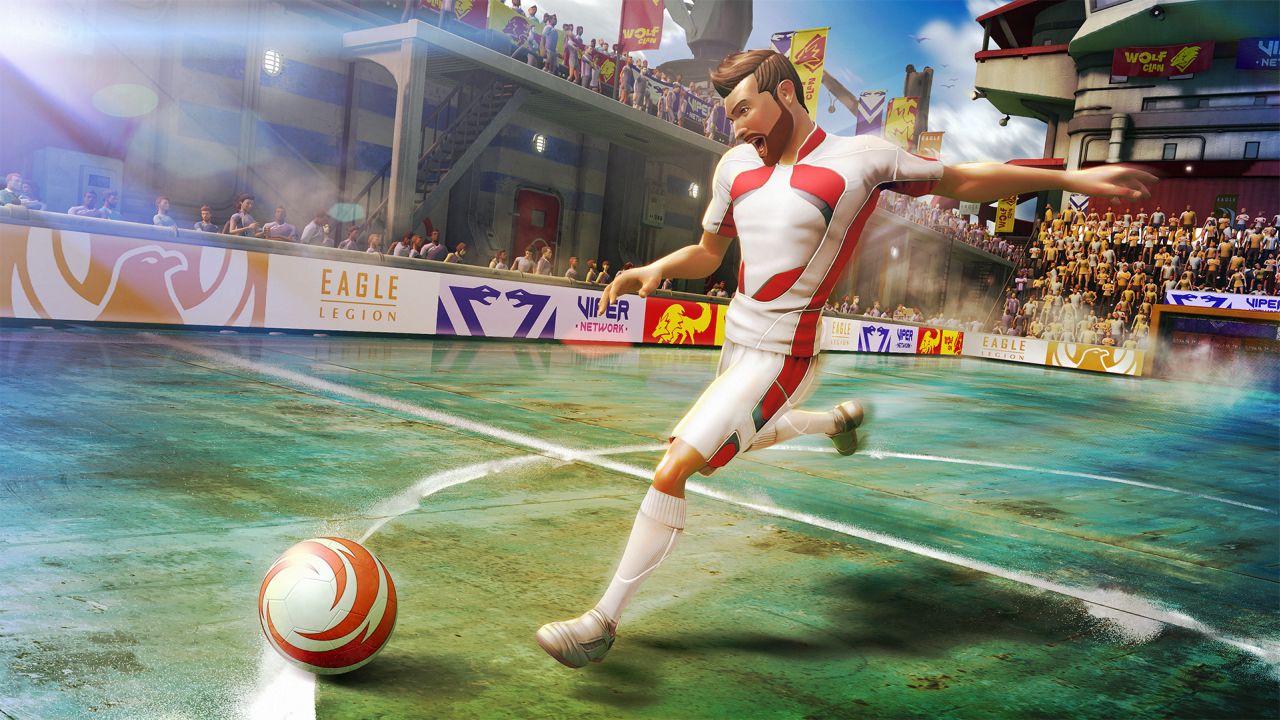
Soccer plays similarly to past Kinect interpretations of the sport. Players take turns attacking and defending. When going up the pitch, you must pass the ball to a teammate ahead until eventually getting into a scoring position and taking a shot. If you pass a certain amount of times, the ball powers-up and makes it more difficult to save. Kinect oddly has trouble tracking the direction of your leg swing at times, leading to intercepts by the opponent. When defending you can only play as the goalie and try to save the shot on net. The save area seems irregularly huge compared to the other sports, requiring you move quite a distance to either side to make a save. It also seems a missed opportunity not to give the defending player any means to interact with the attacker while the ball is being passed up the pitch towards goal.
There are four pitches to play on, and the power-ups are goal shield, super charge, and time steal. The first two are self explanatory, helping directly with attack and defense of your goal. Time steal is a bit of an annoyance – the time allowed to pass and shoot is short already, and Kinect tracking falters often enough by not registering your passes, further wasting time. Still, Soccer is an enjoyable enough experience that can appeal to most players.
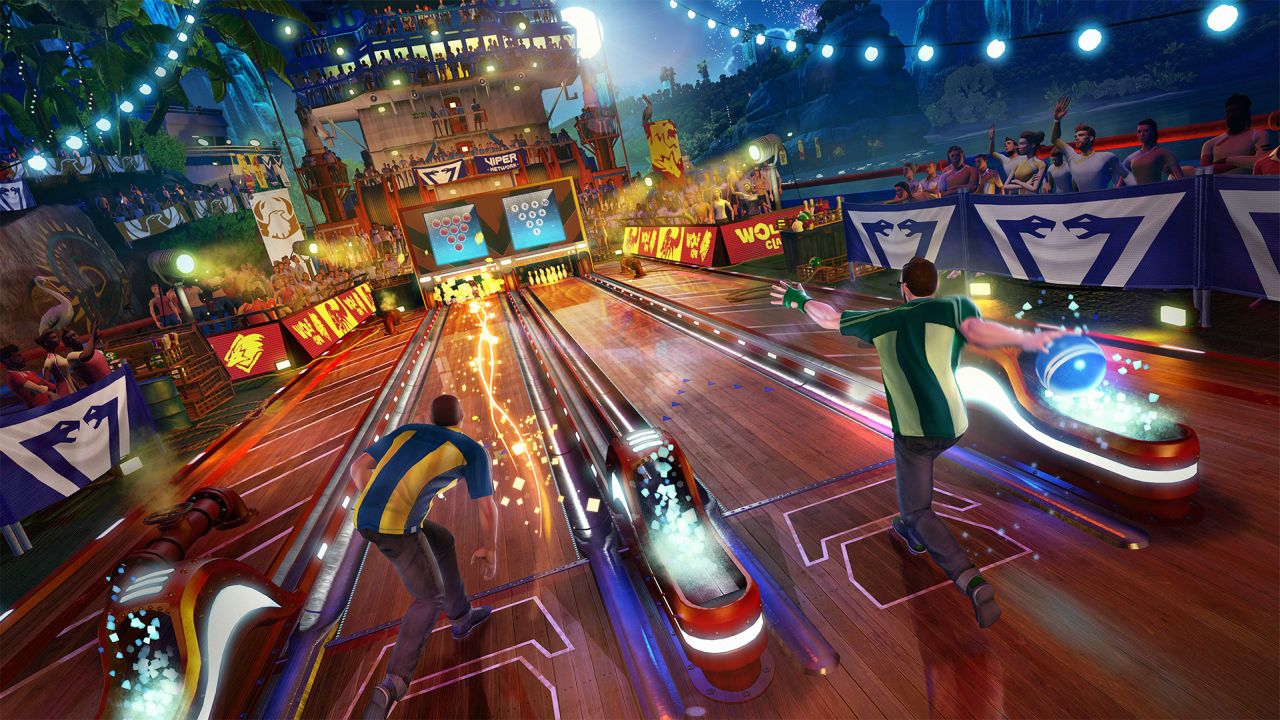
Bowling is a similarly basic implementation of the sport. Pick the direction of your bowl by moving left or right, swing your arm and let it go. While the direction and power of the players’ swing is tracked fine, the game points out that you can also do swerving shots by flicking your wrist as you swing. However, after trying with multiple players and Champions, Kinect seems oblivious to any wrist movements. Swing slow or swing fast, pulling off curved shots seems to be a random and rare occurrence. Most of the time, your shots end up in a straight line. It’s disappointing to see this after the tutorial claims it to be one of the new features of Kinect tracking. Your power-ups are hand switcher (forcing opponent to use a different hand, not exactly a big deal), speed bowl, and meteor ball. The latter is supposed to supersize your ball, but it is seemingly ineffective, beyond the visual effect.
The final event is Tennis, and it also sadly suffers more problems with Kinect tracking. It’s surprising because the other sports never had an issue tracking your arms. Here, missed shots and ill timed swings are commonplace. You can execute multiple different swings when you do connect with the ball, and there is some strategy on when to use the various shots. The body positioning also feels awkward and stiff, as you’re never sure if your Champion is setting up for a forehand or backhand. The power-ups here are energy boost, super racket, and disruptor racket. We’ve tried all three, and they didn’t have as much impact on the rounds as they do in other sports.
Each completed sporting event earns you coins, fans, and XP. The XP is separate for each sport, so playing a lot of soccer will level you up in that event only. Fans are your overall profile progress tracker, earn enough and you get moved up across divisions that unlock new costumes for your Champion, but that’s about it. Finally, you also earn coins, which are used in the shop to buy new outfits and sport items. The latter is important, because in order to actually use more than the starting power-ups, you must buy new items. This includes new rackets for tennis, soccer balls, guns for the shooting range, and so forth. Each new item you buy offers one of the three power-ups and with either increased charge or duration. After a few hours of play it is easy to unlock at least the three basic power-up items for each event, and that works fine for friendly split-screen multiplayer or competitions between friends online.

Or, you can also use the in-game micro-transactions to speed up the process. Because these sport items are relatively expensive, players that want to compete globally with the best gear will need to grind events. To unlock the most powerful versions of the power-ups, it is easily feasible to spend tens of hours playing the sport events, and the game definitely feels skewed towards micro-transaction purchases for players that want to compete globally by using the best equipment. So take that for what it is – likely a non-factor for most players.
While Kinect Sports Rivals offers enough fun activities, the issues with Kinect motion tracking remains a hindering factor in many events, as has been mentioned. The camera needs to see your full body at all times, even when feet aren’t involved such as in shooting or wake racing. If you step out of optimal view, the game will intrusively remind the players to step into a better location – without pausing the game. It’s rather an annoying distraction mid-race that will definitely cost you. In split-screen local multiplayer, the game also complains in a similar fashion if the players are too close together, again disrupting the experience without pausing.
Multiplayer is one of the key aspects of a game subtitled Rivals. All stats and leaderboards are accessed via a companion application called Kinect Sports Rivals Hub. It’s a wholly separate app on your dashboard and can be launched independently of the game. Here, you can track all your scores globally or amongst friends, broken down by event and further by location. While staring at standings is fun, you’ll be more interested in the ability to invite players for direct head to head online matches, or as mentioned play locally with a friend.
The game also offers asynchronous multiplayer with the Rivals system. The main menu will automatically recommend Rivals to challenge from your friends list or global standings, letting you play an event to set a score and then send the results. Your friends will then get prompts to accept the Rival invitation and try to beat your score. Should they succeed, the challenge returns to you and so forth. Like Forza Motorsport 5, your Champion is stored in the cloud, so they will actually appear in other players’ games and compete on your behalf.
With regards to presentation, Kinect Sports Rivals looks solid in HD. There’s nothing particularly standout about the visual presentation or effects, but all sports run at a steady framerate and offer a vibrant color palette. Character animations are smooth and respond to player movements in real time. The great licensed soundtrack is worth mentioning, as it includes some modern techno tracks to get you motivated. The loading times with our digital download version of the game were noticeably elongated.
As the Xbox One aims to captivate the hardcore gaming audience with the likes of Titanfall and Ryse, there is still a market for players that want a more casual, multiplayer friendly experience. Kinect Sports Rivals is clearly aimed at such an audience, as were Rare’s previous Xbox 360 titles. With six sports games, clean presentation and extensive multiplayer options, the developers have certainly hit the mark. However, some sports fall short, in both design and Kinect 2.0 tracking. For a full priced title, Rivals doesn’t offer a whole lot, but there is potentially limitless replay value here. If you’re seeking an Xbox One title to impress your non-gaming friends with, Kinect Sports Rivals could be that game. Following a stumble or spectacular wipeout, you’ll join friends in laughter, almost forgetting it was caused by a Kinect tracking issue.