



Marlow Briggs Review
Marlow Briggs is dead. Fortunately for gamers, his death makes him a formidable fighting machine in this new action-adventure game from ZootFly. Death is thrust upon Marlow during the opening cut scene, before players engage in any action. During this first cut scene, Marlow’s girlfriend tries to quit her job as artifact translator for a powerful man. Mr Long, her evil employer, will not allow this when she is needed to release power within ancient artifacts. She is taken against her will and Marlow is skewered like a shish kebab. It just so happens that the utensil used against Marlow is linked to a Mayan Death Mask. This Mask brings Marlow back to the world with ancient powers and a thirst for revenge.
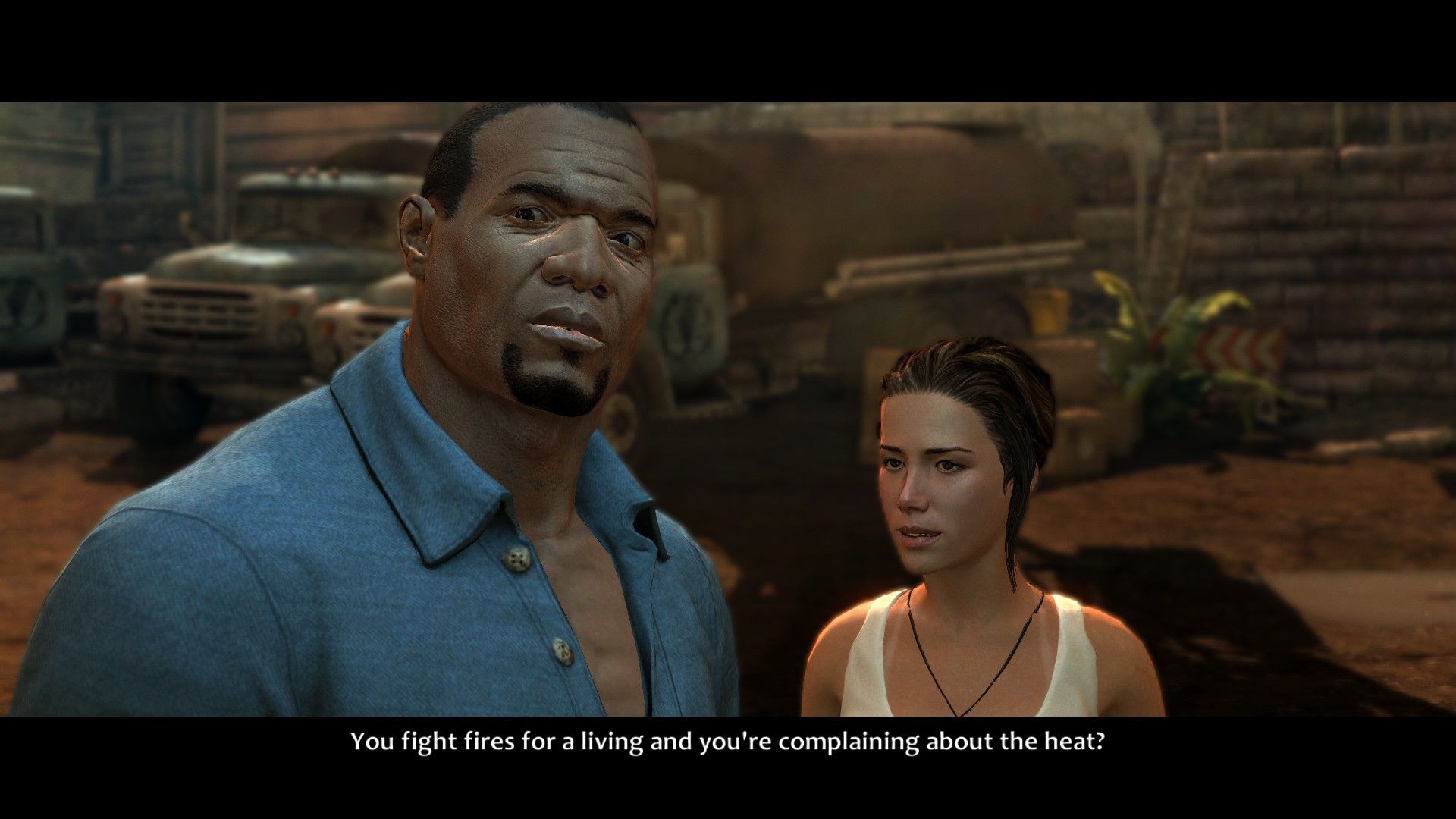
Marlow Briggs before his death, and the only time he wears a shirt
The Mask joins Marlow on his quest for vengeance throughout tropical rainforests, snowy mountains, caves, and industrial machines. The Mask refers to Marlow as the Sacred Warrior, or Chuchu when it wants to be less formal. Marlow and the Mask banter outside the action, although this rarely provides the intended humour. The benign tale lacks distinctive character although there are strong themes relating to the industrial infesting the natural. The Mask is generally a voice that belittles you when you accidentally stumble to your death. The story is far from the main strength of this arcade adventure.
Marlow Briggs is all about fighting, and the game draws heavy inspiration from God of War and Darksiders. The mechanics are simple enough: you fight against a wonderful array of different enemies while chaining combinations for more points. These points can then be spent on damage upgrades or extra mana reserves. Mana will fuel ranged attacks or special, devastating abilities. Marlow may be dead, but his health can drop and cause a second, or final, death. Fallen enemies release orbs containing health, mana and experience, bringing the system full circle.
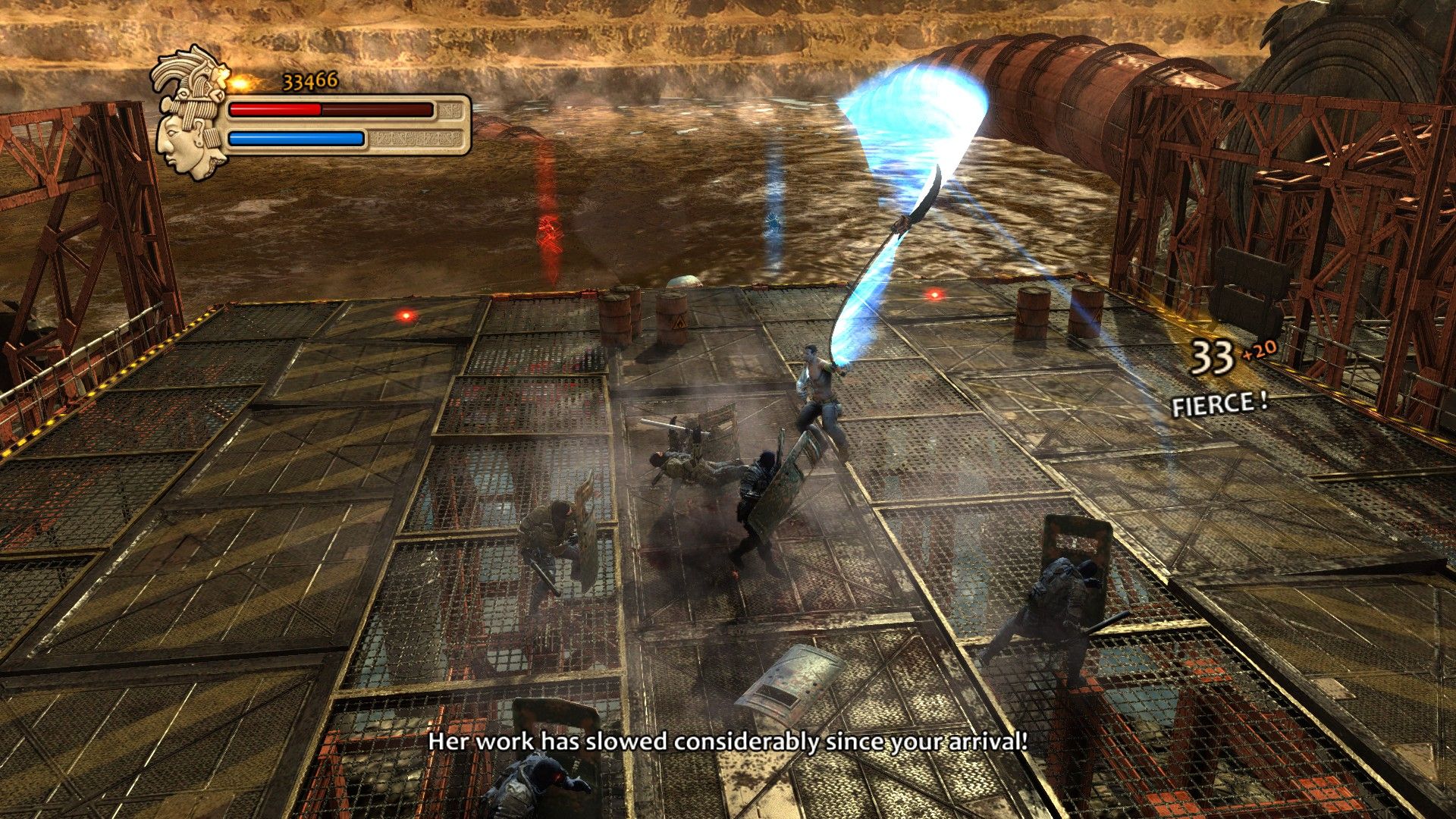
The game does nothing to cure my hatred of riot-shield enemies
Marlow wields four weapons during his adventure. The weapons types are easy to predict: Scythe, Daggers, Chain and Hammer. After unlocking each, the previous weapons become fairly redundant. The Chain, for example, has a large attack range and looks amazing compared to puny daggers. When you get your hands on the Hammer, there is little reason to use anything else. The Hammer secondary attack can easily interrupt large enemies and provides hefty damage. You might switch back to the chain when dealing with dozens of small spiders, but the necessity is rarely there. There was never a reason to equip the Scythe or Dagger during the second half of the game and there isn’t enough diversity between weapon types.
Powerful offensive spells are granted to Marlow much like the new weapons. These spells are disappointing because they consume a huge chunk of mana and obstruct the screen with gregarious effects. The unlocked powers might freeze foes or create a mini-tornado that eliminates smaller creatures. They aren’t nearly effective enough against the tough enemies, which is the only time you really want to use them. Since you can only perform one powerful attack before refilling on mana, they don’t fit well within the combat structure.
The combat rarely changes from mashing attack buttons, even though enemy types are varied. Marlow does have access to a ranged throwing knife, but this is only used effectively against the floating wasps. Marlow can block attacks too, although some attacks ignore the block and pummel Marlow into the ground. The block is used almost exclusively to deflect RPG missiles fired by soldiers. Larger enemies, like scorpions, can be commandeered after they take enough damage and Marlow becomes invulnerable until his rodeo ride is killed. Some enemies can be turned to fight on your side and this is a godsend during combat against multiple enemy types. Although there are several combat mechanics, more balancing was needed to promote their usefulness outside specific scenarios.
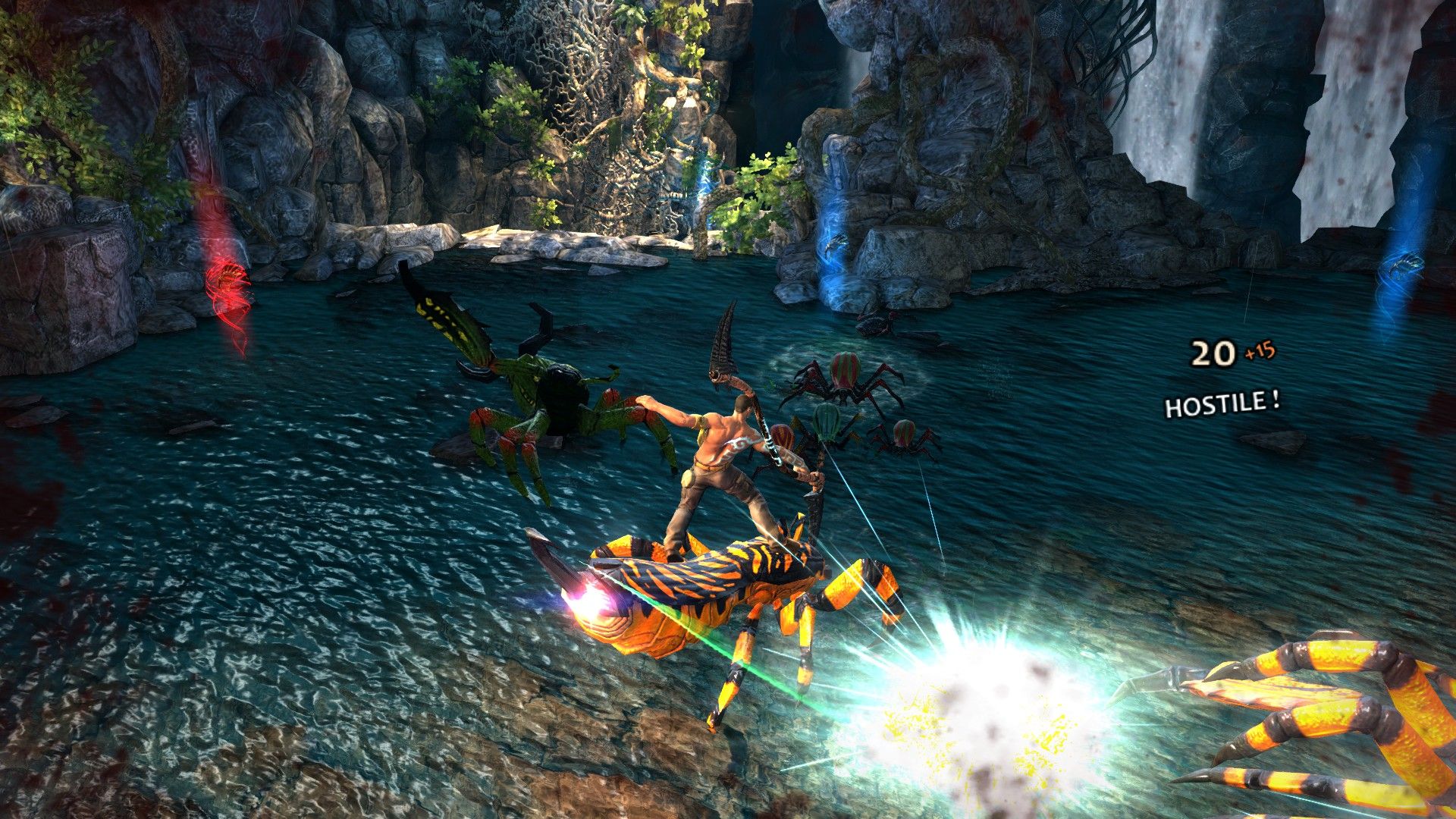
Riding enemies provides fleeting satisfaction
Combat is not the only device that Chuchu, or rather Marlow, will be subjected to. In a similar vein to Darksiders, there are platforming and puzzle segments. Most puzzles involve a movable box or pressure switches. Puzzles are very basic although they may not initially seem that way. Platforming is the main device used to break players from the action. The platforming can see Marlow climbing vines, swinging across chasms or dodging balls of fire. Platforming is either easy or painfully designed. The most pain is felt when you acquire the nifty gliding power and need to latch onto grapple points. It seems straightforward, but you cannot grab points while gliding, so you must stop gliding and hope that Marlow latches on before falling to his death.
Arcade segments are repeatable and serve to further break the game from fighting monotony. You might slide down an incline and dodge rocks or jump over gaps. Turrets can be controlled to shoot down endless waves of helicopters. There are even two top-down shooter sequences that have you flying aircraft and shooting down more helicopters. These micro components are rudimentary, but they do slice up the action segments and are easy to play through.
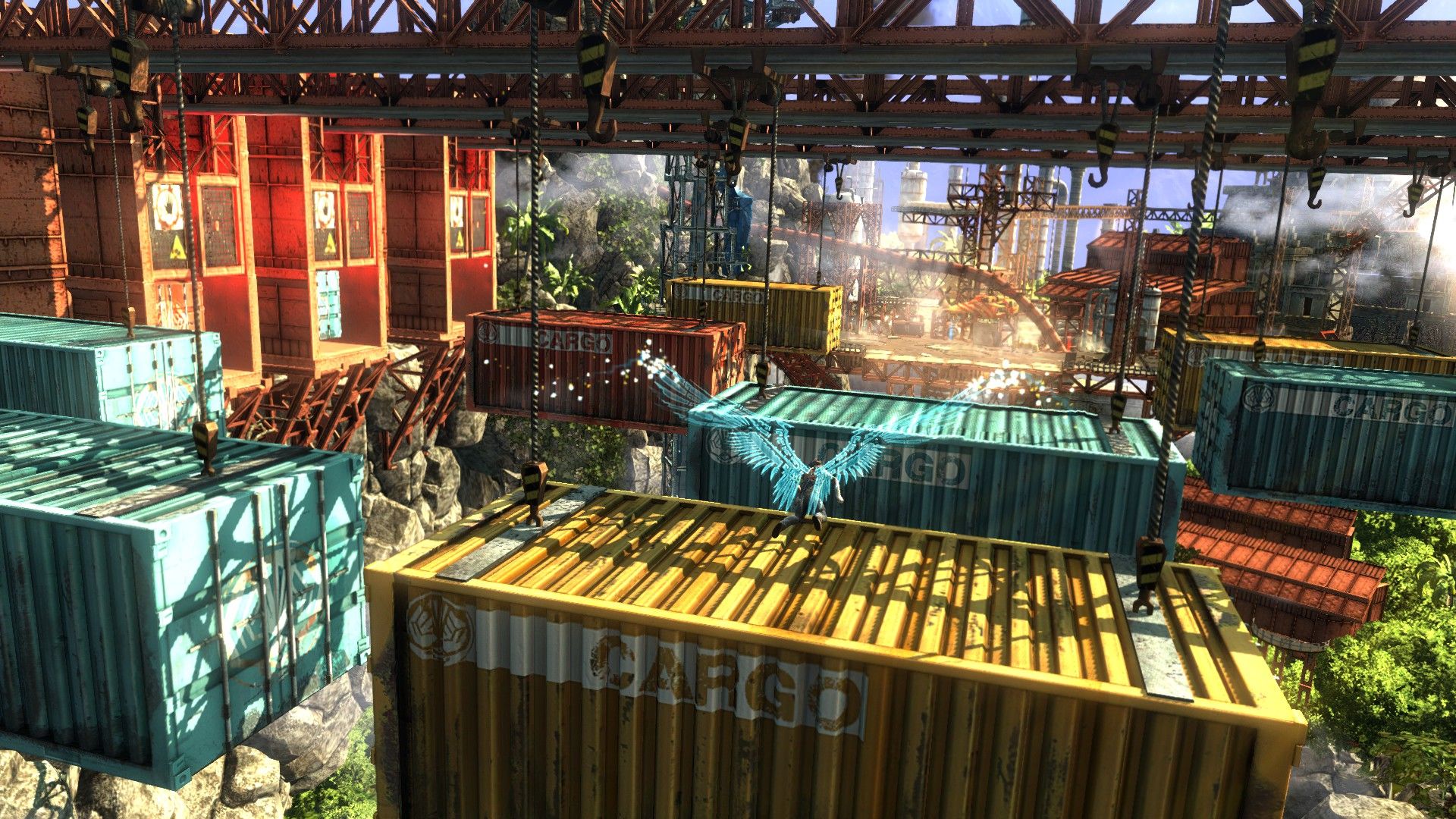
Some platforming sections are more difficult because of the flawed camera
The biggest mechanical fault with Marlow Briggs is the problematic camera design. The camera is not fixed to Marlow, instead it perches itself at the edge of areas and focuses directly at Marlow. When you move to the corner of the screen, Marlow may vanish behind walls. Enemies positioned between Marlow and the camera are usually not visible, so you have no idea if they are preparing to attack. Fighting huge enemies when they are far from the camera is like trying to hit a piñata while wearing a blindfold. During platforming, the camera regularly adjusts position to make distances harder to judge. Sometimes the camera moves so you cannot even see the platform you need to jump on. Most of the time the camera captures the action, but the other times will have you wishing for a different system.
Presentation qualities are above average for a game in this price range. The engine does a great job when rendering lush environments, although most areas are small. It is only during some of the later scenes, when you glide large distances, can you appreciate the engine and artistic design. The saturation and palette selection is reminiscent of the original Uncharted, although without the texture resolution to match. The game does have standard cut scenes, but it tears away from the norm by using swooping freeze frame montages that convey action without movement. Moments in time are showcased as the camera circles the action, cutting to a new scene each time the camera is obscured. Although some last too long, this simple device provides enough detail to replace cut scenes, feels unique, and tickles your imagination.
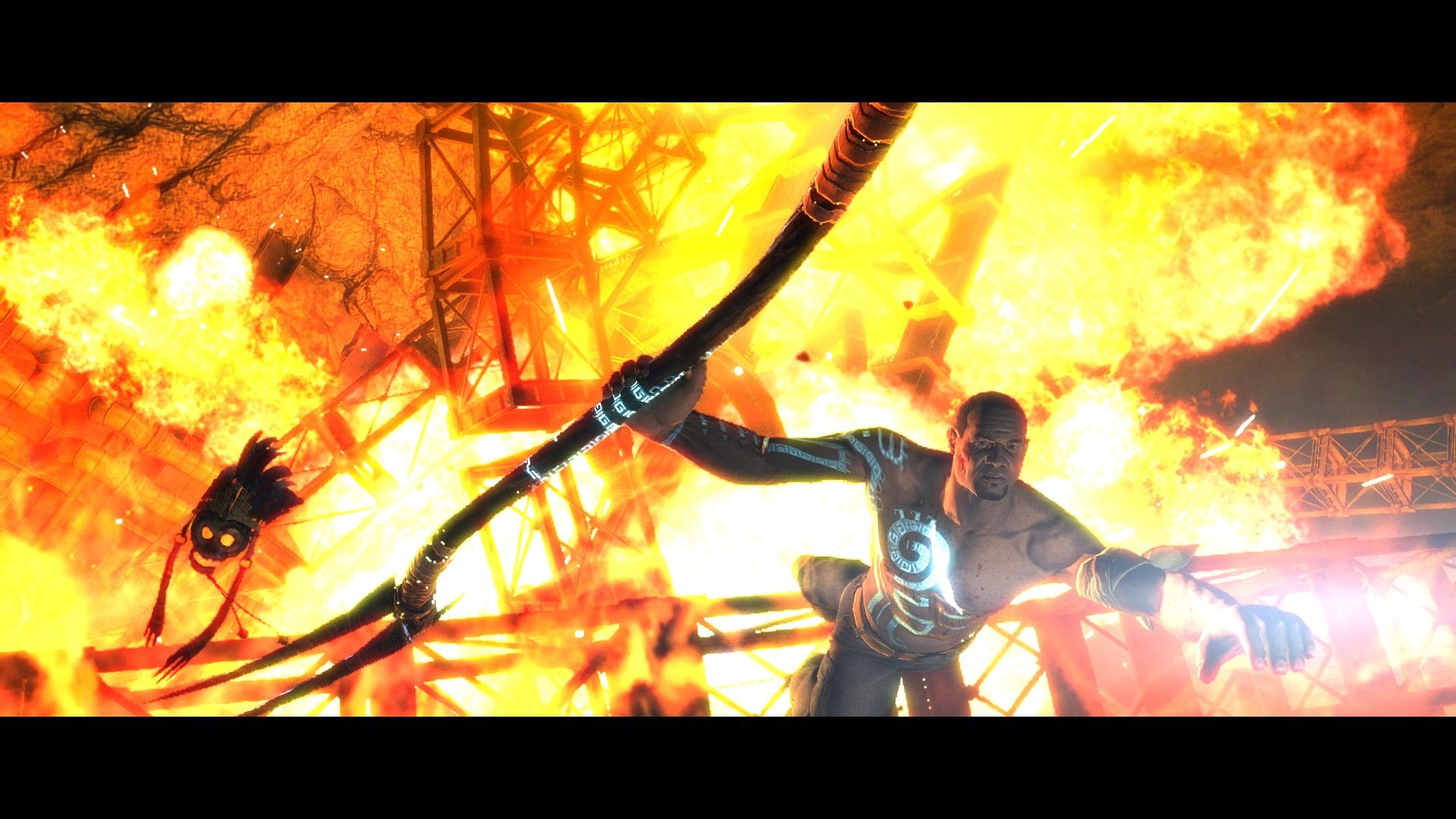
Freeze frame montages are actually pretty effective
Marlow Briggs and the Mask of Death is not a game without positives, but the experience is forgettable and rarely brings consistent enjoyment. The camera is awkward during combat and a nuisance when jumping across chasms. The action and weapon systems needed further refinement before everything gels together like similar games. Thankfully, the enemy types are varied and the chain is great fun to use when you mix up the combos. Ultimately, Marlow Briggs is a simple arcade adventure that chokes on flaws and lacks a strong feature that would bring it back to life.